Note: Due to the winter holidays, we will be taking a short break from this newsletter after this week. You can expect to receive your next issue on Friday, Jan. 16.
New Internal Funding Opportunities to Spark Innovation and Collaboration
In addition to the School of Education Incubator Grants announced in the last issue of this newsletter, the School of Education and the Office of Research & Scholarship are excited to announce an additional new internal funding opportunity to advance innovative research, scholarship, and creative endeavors. These programs reflect our commitment to the Wisconsin Idea and our strategic priorities—empowering faculty and staff to pursue bold ideas that improve education, enhance well-being, and build community.
One School Innovation Fund
Generously supported by Dean Haddix, the One School Education Innovation Fund will catalyze interdisciplinary, community-engaged research and scholarship that addresses complex social and cultural challenges. This program supports projects aligned with the School of Education’s strategic plan and offers two funding tracks:
Seed Grants: Up to $25,000 for early-stage work such as team formation, stakeholder engagement, and proof-of-concept development.
Engage Grants: Up to $80,000 for pilot projects, demonstrations, productions, or presentations.
Key Deadlines:
- Letter of Intent (encouraged): Jan. 9, 2026
- Full Proposals: Feb. 25, 2026
- Funding begins July 1, 2026
Eligible applicants include faculty and academic staff with home departments in the School of Education. Proposals that involve graduate students, explore new research directions, and align with the Wisconsin Idea are strongly encouraged.
Learn more about the One School Innovation Fund on the ORS website.
School of Education Incubator Grants — Deadline Extended
The Incubator Grants program provides flexible funding to help faculty and staff develop early-stage ideas into competitive proposals for external funding. These grants are ideal for projects that require preliminary data collection, partnership development, or proof-of-concept work, such as the recently announced I3 initiative led by the Office of the Vice Chancellor for Research (OVCR). Originally announced in the Dec. 5, 2025 newsletter, the deadline to submit a proposal has been extended to Jan. 30, 2026.
Learn more about Incubator Grants, including how to apply, on the ORS website.
News and Announcements
As a reminder, Administrative Services staff will continue to offer in-person assistance on Dec. 22, 23, 29 and 30, 2025. You can expect staff to be fully remote on Dec. 26 and Jan. 2, and staff will be available to offer virtual assistance via email. Happy Holidays!
Please reach out to the Office of Federal Relations if you are considering submitting comments to the federal government in response to a proposed rule change or request for information in your capacity as a university employee. Given the variety of ongoing legal and policy changes happening at the federal level, any official comment must be reviewed and approved by the Office of Federal Relations, Office of Strategic Communication, and the Office of Legal Affairs. Additional information is available on the Office of Federal Affairs webpage.
Are you interested in learning about submitting a winning grant proposal to NIH? Join School of Medicine and Public Health (SMPH) colleagues on Feb. 12–13, 2026 for a 2-day “Writing Winning NIH Grant Proposals” seminar. There is a $100 textbook fee for UW–Madison faculty and non-faculty outside of SMPH; email ORS for assistance covering the cost for SoE participants. Learn more and register on the seminar webpage.
The ORS Pre-Award team is prepared to assist with recent NIH policy changes. Please review the following important notices:
- Updated application policies — NIH will no longer request or accept Letter of Intent as part of the application process, and NIH will no longer require applicants requesting $500k or more in direct costs to contact the Institute or Center (IC) before submission.
- Common Forms (effective Jan. 25, 2026) — Biographical Sketch, Current and Pending, (Other) Support, and NIH Biographical Sketch Supplement in Common Forms format will be required for all submission types. Malign Foreign Talent Recruitment Program certification will also be required.
Also from NIH this week: NIH is committed to maintaining a rigorous grant peer review process. Review their recent communication for how they are handling the backlog of applications and moving forward with the next cycles. There are benefits to becoming a reviewer and participating in the NIH Early Career Reviewer program.
A new round of seed grant funding from EdPrepLab, an initiative of the Learning Policy Institute and Bank Street Graduate School of Education that aims to strengthen educator preparation, has been announced with awards of up to $10,000 to support science of learning and development-aligned, cross-institutional research and collaboration. The priority deadline for submission is Jan. 30, 2026. Review the call for proposals and learn more about upcoming information sessions online.
Earlier this week, the OVCR released details of an internal competition for tracks 3 and 4 of NSF 25-548: Accelerating Research Translation (ART). Additional information about the RFP is available on the NSF website. The internal competition deadline is Jan. 12, 2026 — review the OVCR website for full details.
The NSF Directorate for Social, Behavioral, and Economic Sciences (SBE), in partnership with the Walton Family Foundation, has announced a new Collaboratory to Advance Mathematics Education and Learning (CAMEL) for the K–12 program. Letters of intent are required for Phase I proposals and are due by 5:00 p.m. submitter’s local time on Jan. 9, 2026. Full Phase I proposals are due on March 11, 2026. Phase II will only be open to Phase I awardees. Get full details on the NSF website.
Earlier this month, the Office of Postdoctoral Affairs hosted a workshop, in collaboration with the B1G+, titled “Best Practices in Grant Writing: From Specific Aims to Training Plans.” Top takeaways according to ORS’s Nicci Schmidt include:
- The NIH funding success rate across training and career awards in 2024 was approximately 33–48%, with the K25 and F99 mechanisms at 48.1%. Data are publicly available at NIH.
- Make sure relevant training is in temporal alignment with research activities.
- A strong Specific Aims is critical. Dr. Lauren Aleksunes has been writing grants for >20 years and still keeps a checklist next to her while she writes to ensure she includes the right ratio of key elements, including only the most important background information, explicit hypotheses, innovation, limited jargon, and strong verbs.
The minimum graduate assistantship pay will increase by 5% starting in the Fall semester of the 2026 academic year and will increase by 5% again for the fall of 2027. The new minimum stipend rates go into effect on June 28, 2026, for annual appointments, and on Aug. 17, 2026, for academic year appointments. The ORS Pre-Award and Post-Award teams will integrate this information into their workflows.
The School of Education’s new $100,000 Student Travel Fund is already making an impact, with 54 students across all 10 departments receiving grants totaling $76,500 in just eight weeks. These funds help students present their research at major conferences, from AERA to professional gatherings in dance and theater and beyond, creating opportunities for networking and scholarly engagement. Visit the ORS website to read the full article.
The 7th annual Data Science Research Bazaar at UW–Madison is now accepting submissions for lightning talks, posters, training sessions, and focused discussions. Researchers, students, and professionals at all levels of expertise can apply to showcase their work at the main conference and other events this spring. Proposals are due Jan. 15, 2026; the main conference will take place on March 19, 2026. Training sessions and focused discussions will be held throughout March and April.
Research by the Numbers
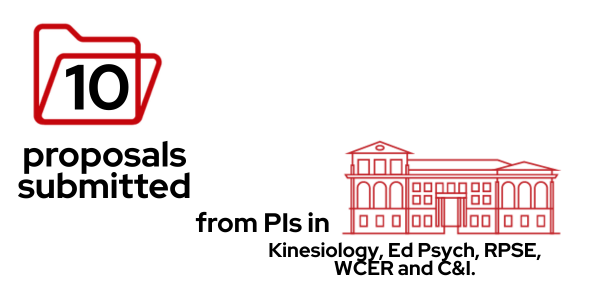
November 2025 remained a busy month for the ORS team as researchers and scholars across the school continue to submit proposals to an array of funders. Award highlights from the month include:
- Evangeline Su, WCER Researcher, received her first award as primary PI from the National Science Foundation for a project entitled “Pilot Study of Professional Development Relationship Building Knowledge Transfer in STEM Teams.”
- Katie Hudnall received extramural funding to host an Artist-In-Residence in fall 2026 — the first time she’ll act as PI on a sponsored project.